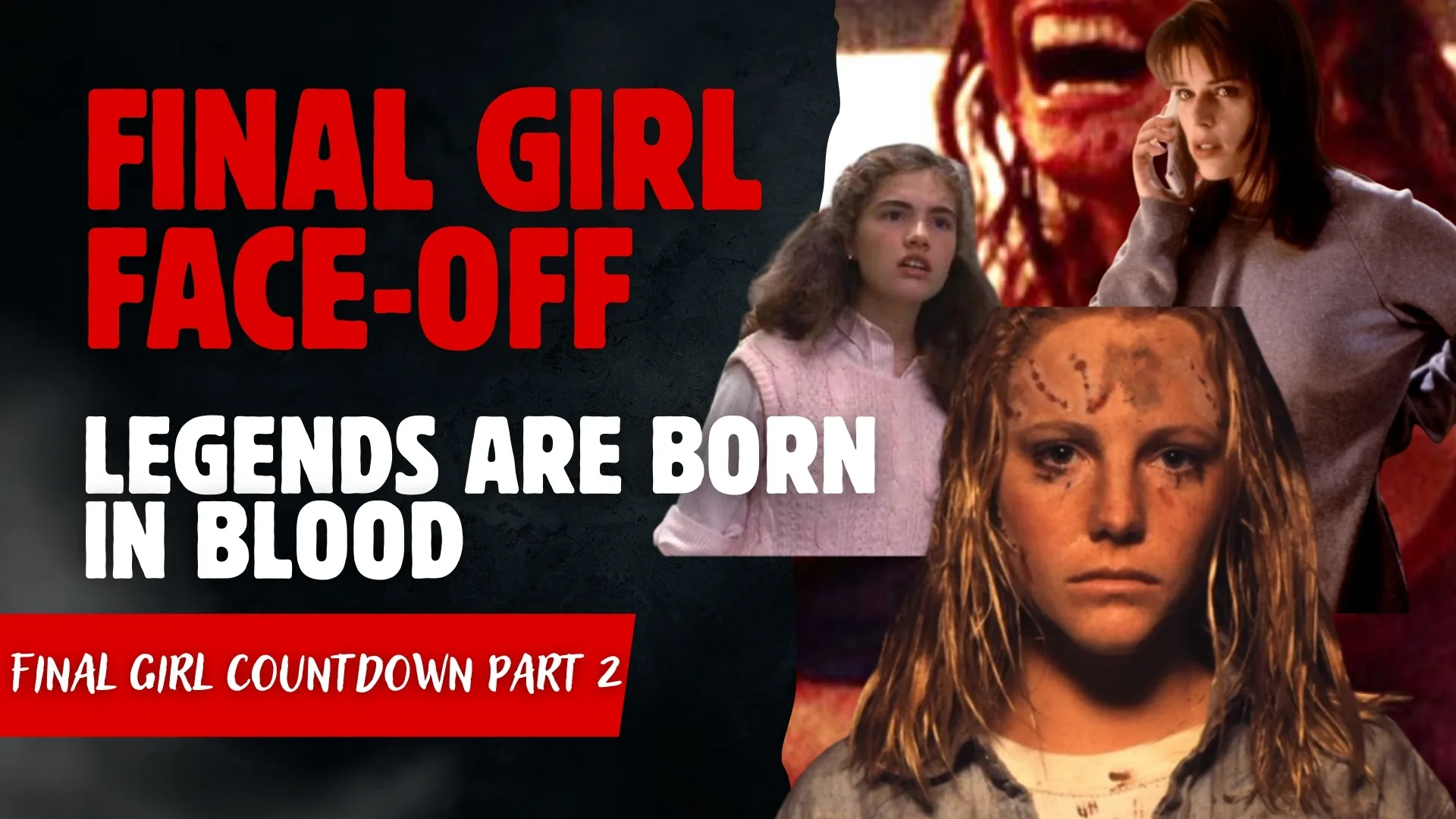
Friends, if you’ve been following along, you know the rules. You know the Four Pillars. You know we’ve already counted down ten through six — Grace, Ginny, Erin, Nancy, and Julie — each one proof that surviving isn’t enough unless you change the genre while doing it.
But now we’re entering sacred territory.
The Top Five Final Girls of All Time
These aren’t just survivors. They’re cultural icons. They’re the ones who rewired horror and reshaped what it means to refuse death. And fair warning: my number one pick? It’s going to piss some of you off. Good. That means you’re passionate.
Let’s do this.
#5 — Sally Hardesty (The Texas Chain Saw Massacre, 1974)
Before Laurie. Before Nancy. Before Sidney. There was Sally.
In The Texas Chain Saw Massacre, Sally endured what is still, to this day, the most brutal horror experience ever put on film. That dinner scene, strapped to a chair while the Sawyer family cackled and tortured her, is pure nightmare fuel. It’s not just scary — it’s traumatic to watch.
Most people would break. Sally doesn’t. She throws herself through a window, runs bleeding through the night, and claws her way onto the back of a pickup truck. That final shot of her laughing and screaming in the sunrise — drenched in blood and madness — is rebirth through trauma.
Sally is the foundation. She’s the blueprint. The Final Girl before the phrase even existed.
So why only number five? Because Sally survived through desperation and luck. The top four fought back with strategy, intellect, and intent. Sally was legendary, but she was also a victim who escaped. The ones above her were never just victims.
#4 — Laurie Strode (Halloween, 1978–2022)
The babysitter. The archetype. The matriarch.
Laurie Strode has been battling Michael Myers for 44 years across multiple timelines, retcons, and reboots. She’s died, been resurrected, and reinvented more times than any Final Girl in history. And through it all, she’s remained the face of slasher survival.
The virginal, responsible teenager in 1978 set the template: pure, cautious, resourceful — while her sexually active friends were butchered. That double standard defined slashers for decades.
But Laurie’s legacy is complicated. She’s had legendary highs (H20 Laurie, hardened by trauma and ready for war) and embarrassing lows (Resurrection Laurie, a moment horror fans pretend never happened). The recent trilogy gave her new life as a scarred survivor, consumed by obsession, whose fight against Michael damaged her family as much as it empowered her.
That’s the paradox of Laurie Strode. She’s more symbol than consistent character. She represents the idea of the Final Girl more than a single definitive version.
She’s iconic. She’s essential. But the top three? They never stumbled. They never had a “bad” movie dragging them down.
#3 — Dana Polk (The Cabin in the Woods, 2012)
The revolutionary.
On the surface, Dana looks like the classic Final Girl: virginal, innocent, “pure.” But The Cabin in the Woods deconstructs the archetype in real time. Dana isn’t just surviving a slasher — she’s surviving a system designed to manufacture slashers.
When she discovers the underground facility, the orchestrated sacrifices, the cosmic order demanding her blood… she refuses. She chooses not to complete the ritual, even if it means ending the world.
That last exchange with Marty — “I’m sorry I almost shot you” — before letting everything burn, isn’t just survival. It’s rebellion. Dana looked straight at the machine that demanded women die for cosmic stability and said: burn it all down.
Dana didn’t just fight a monster. She fought the system that creates monsters. That’s not survival. That’s revolution.
#2 — Kirsty Cotton (Hellraiser, 1987–1989)
The most underrated Final Girl in horror. Period.
While most Final Girls face maniacs, killers, or masked monsters, Kirsty Cotton faced demons from literal hell — and won. Not by running. Not by stabbing. But by negotiating.
When the Cenobites corner her with their infamous promise — “We have such sights to show you” — she doesn’t scream. She bargains. She offers Frank instead of herself. She outsmarts the unspeakable by recognizing they’re bound by rules.
That’s Kirsty’s genius. She understood that survival isn’t always about brute strength. It’s about knowing the rules of the nightmare better than the monsters do.
Across multiple films, Kirsty turned horror into a chess game — and she never lost. She is the definition of intellect over instinct.
#1 — Sidney Prescott (Scream, 1996–2023)
The Queen. The legend. The evolution.
Sidney Prescott has survived five Ghostface killing sprees across nearly three decades. But survival alone isn’t what makes her number one. It’s how she evolved.
In Scream, she’s the classic virginal archetype — traumatized by her mother’s murder, still “pure” by slasher logic — but she’s already sharper than most. She identifies the killers, fights back, and survives because she’s smarter, not just luckier.
In Scream 2, she’s a trauma survivor trying to move forward, only to be dragged back. She adapts. She becomes harder, faster, more strategic.
By Scream 3, she’s reclusive, scarred, resigned to a life where the nightmare never ends. But when Ghostface finds her, she doesn’t just hide — she confronts the source of her trauma head-on.
Scream 4 shows her transformed: an author, a mentor, someone who uses her scars to help others. And by Scream 5 and 6, she’s legend. The final boss of Final Girls. The one Ghostface killers target specifically because beating Sidney would crown them as ultimate.
Sidney’s cultural impact is unmatched. Scream revived the slasher, invented meta-horror, and every horror film since 1996 has lived in its shadow.
Her kill count? The highest of any Final Girl. Her longevity? 25+ years of relevance. Her arc? Victim → survivor → hero → legend.
Sidney didn’t just play the game. She rewrote it. She didn’t just survive. She transcended.
That’s why Sidney Prescott is number one.
Wrapping Up
There it is. The definitive top five:
- #5 Sally Hardesty — the foundation, reborn through trauma.
- #4 Laurie Strode — the matriarch, iconic but inconsistent.
- #3 Dana Polk — the revolutionary who refused the system.
- #2 Kirsty Cotton — the intellect who outsmarted hell.
- #1 Sidney Prescott — the legend, the evolution, the eternal survivor.
Mad about the rankings? Good. That means you care. That means horror still matters.
Drop your own list. Argue with mine. Tell me who I got wrong. Hell, write your own countdown and tag me. Because the Final Girl isn’t just a trope. She’s a conversation.
Until next time… keep collecting the stuff they don’t want you to remember.
Leave a Reply