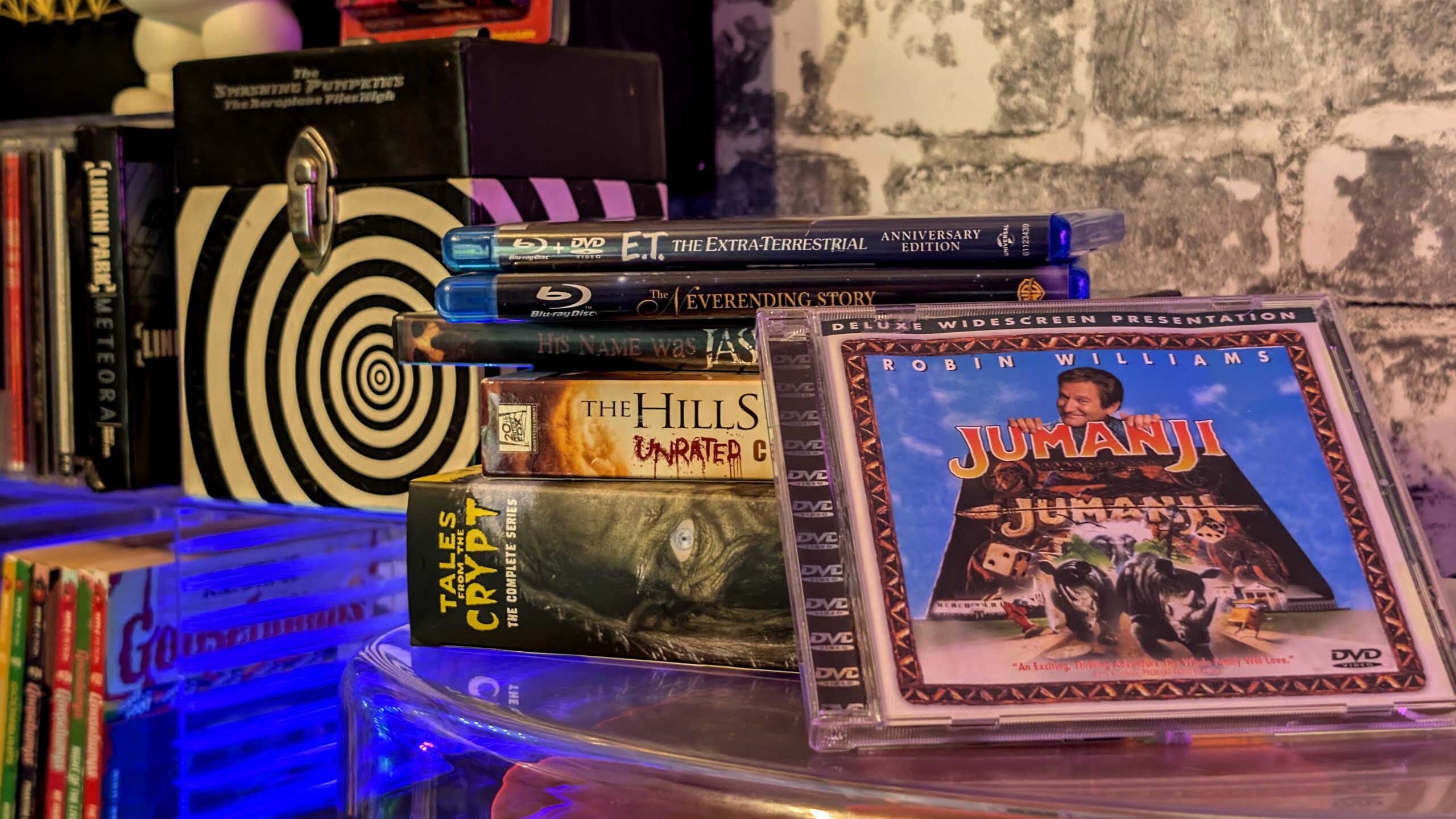
Physical Media Is Memory You Can Hold
In an age where everything streams and catalogs shift overnight, there’s power in holding the real thing — a disc, a tape, a sleeve meant to be lived with, not scrolled past. Physical media isn’t dead. It’s alive in the hands of collectors and archivists who refuse to let memory be reduced to bandwidth.
Further reading: The Role of Nostalgia in Horror Fandom · The Art of Horror Movie Poster Design in the ’80s & ’90s · House of 1000 Corpses: Collector’s Guide
Permanence Over Permission
Streaming is a lease. Rights expire, libraries evaporate, and the films that shape us vanish behind contracts we can’t see. A VHS spine, a Blu-ray slipcover, a steelbook with alternate art — they don’t disappear when a platform decides they’re not profitable. They wait. They persist.
Presence and Ritual
Playback becomes ceremony. Sliding a disc into a tray, rewinding tape, flipping liner notes — small gestures that slow time and give weight to the act of watching. You don’t background-play a movie you chose to pull off the shelf. You commit to it.
The Collector’s Impulse
For some, it’s the hunt: misprints, limited runs, boutique restorations that streaming will never replicate. For others, it’s biography — the first rental card, the poster on the wall in ’95, the DVD worn thin in college. Formats become artifacts; artifacts become a map of who we were when we first pressed play.
Related reading: Poster Design in the ’80s & ’90s
Convenience Has a Cost
Algorithms simplify choice but centralize power. When you let the machine decide what’s available, you surrender control. Physical media is refusal — a personal archive that says, “I decide what stays.”
The Object’s Story
Faded rental stickers, booklets tucked into trays, feature-length commentaries and behind-the-scenes docs lost to streaming — the object carries its own narrative. That narrative is part of film history, and history shouldn’t be parked on servers that can blink out overnight.
Horror’s Shelf Life
Horror thrives in the tactile. Grime, grain, poster grit — the ephemera that boutique labels resurrect with care. One film can live multiple lives across formats; House of 1000 Corpses is proof, multiplying through DVDs, Blu-rays, steelbooks, and that elusive VHS.
Related reading: House of 1000 Corpses: Collector’s Guide
Why It Matters
Physical media protects more than movies; it protects the context that gives them meaning. Preservation isn’t nostalgia for its own sake — it’s cultural memory against cultural decay. When we build shelves, we’re not hoarding plastic. We’re maintaining access, authorship, and history on our own terms.
Wrapping Up
Physical media is memory you can hold — a rebellion you can touch. If this resonates, spend a night with something from your shelf. Read the booklet. Watch the commentary. Then tell me what detail you found that streaming left behind.
Explore next: Nostalgia in Horror Fandom · Poster Design ’80s/’90s
Leave a Reply